

Long-Term Alcohol Biomarkers in Umbilical Cord Tissue
Long-term Alcohol Testing
in Umbilical Cord Tissue
 Read About Our Research:
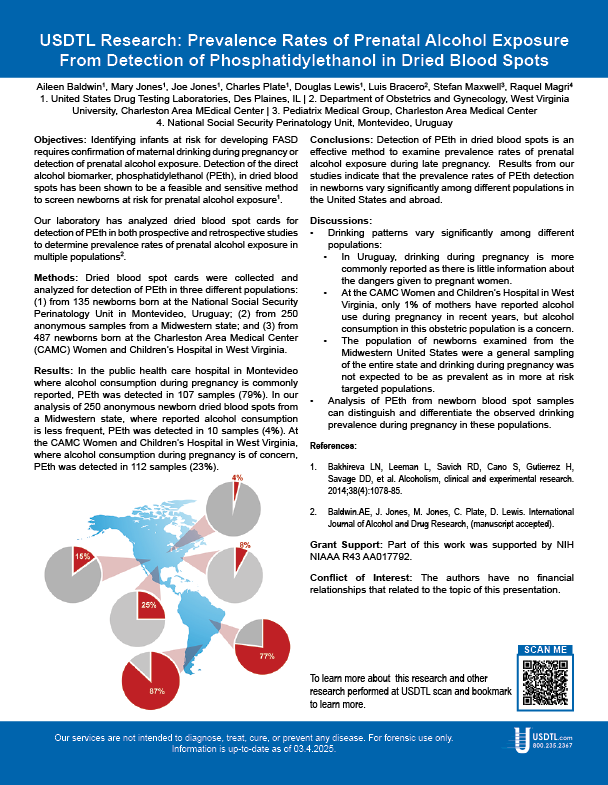
Prevalence Rates of Prenatal Alcohol Exposure From Detection of Phosphatidylethanol in Dried Blood Spots
Authors: Aileen Baldwin1, Mary Jones1, Joe Jones1, Charles Plate1, Douglas Lewis1, Luis Bracero2, Stefan Maxwell3, Raquel Magri4
1. United States Drug Testing Laboratories, Des Plaines, IL
2. Department of Obstetrics and Gynecology, West Virginia University, Charleston Area Medical Center
3. Pediatrix Medical Group, Charleston Area Medical Center
4. National Social Security Perinatology Unit, Montevideo, Uruguay
This information was presented at a recent conference.
What is Ethyl Glucuronide (EtG)?
 EtG is a metabolite formed in the body following exposure to ethanol, also called ethyl alcohol (grain alcohol), making it a direct ethanol biomarker.
Testing for alcohol use using indirect ethanol biomarkers can be inconclusive, given different conditions and diseases that can affect certain organs and tissues. Using a direct ethanol biomarker helps focus the result on exposure to ethanol.
Why Screen Newborns for Alcohol Exposure?
Children exposed to alcohol in utero may suffer from a range of neurological and developmental disabilities known as Fetal Alcohol Spectrum Disorders (FASD).
The most severe cases result in Fetal Alcohol Syndrome and appear with a variety of distinguishable physical defects as well as developmental and cognitive disabilities. Milder cases of FASD are challenging to diagnose and are usually not recognized until later in a child’s life when social and cognitive problems develop. Click the “Contact Us” button below to receive a notification about our upcoming FASD ToxTime Webinar.
Watch Our ToxTime!
USDTL provides free educational virtual events called ToxTime; we have included a few of the most relevant sessions below. Register for our upcoming ToxTime Event!


Visit Our Events Page For More ToxTimes
Additional Resources
USDTL Research: Using Umbilical Cord Tissue to Identify Prenatal Ethanol Exposure and Co-Exposure to Other Commonly Misused Substances
USDTL Research: Identifying Alcohol-Exposed Newborn
USDTL ToxTime Event: Evidence-based Newborn Toxicology
Would you Like to Learn More?
We are here to clarify the confusion surrounding substance use toxicology and answer your questions. Please do not hesitate to contact us at newborn@usdtl.com or 800.235.2367.
Contact USDTL
1.800.235.2367
Client Services
Business Hours (CT)
Mon.-Fri. 7am-6pm
Sat. 8am-5pm
Holidays Closure
New Year's Day
Memorial Day
Independence Day
Labor Day
Thanksgiving Day
Christmas Day
Request Your Collection Supplies
For your convenience, USDTL provides test collection supplies at no additional charge.
Newsletters, Posters, and Catalogs
Our print materials will keep you up to date on the latest news in drug and alcohol testing.